On Reading: The Doorman - Understanding the Room and the Moment

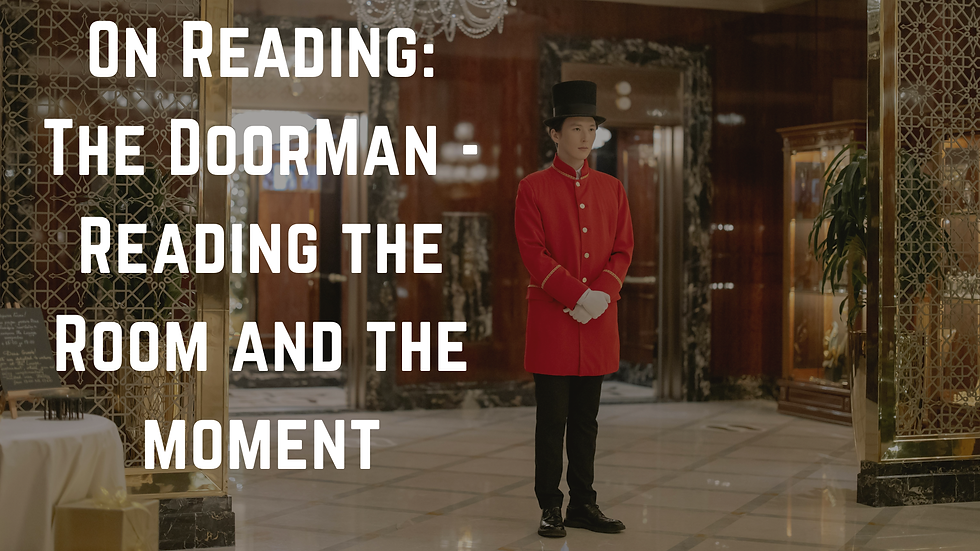
I recently finished reading The Doorman by Chris Pavone. A very contemporary novel that reads like the blend of a satirical critique of the current cultural moment and a thriller. The book looks at power that comes from wealth, whiteness, reputation, and location, but really it’s about who understands and can read the room and the moment.
The story revolves around a few essential characters. First, Chicky Diaz, the doorman at the luxury condominium where the other characters reside. He’s the Everyman, stuck in the orbit of those more powerful than him. There’s Whit Longsworth, the billionaire arms dealer and his wife Emily, the woman who manages their reputation. Finally, there’s Julian Sonnenberg, an art gallerist and Emily’s affair partner.
They all inhabit the same building. They do not all understand power the same way.
Observation #1: The Smallest Dent Feels Existential to the Most Powerful
On paper, Whit wields the most power. He’s rich, connected, known to use litigation as a weapon. His dominance feels unquestioned.
Yet he is the easiest to destabilize.
Any suggestion that his power isn’t absolute produces fractures. A bruised ego leads to escalation — even when there’s no real material threat.
There’s a broader pattern here. When dominant groups perceive even minor symbolic dents in status, the reaction often far exceeds the actual risk. We saw this during Reconstruction, when expanding rights to formerly enslaved people was framed as “Black supremacy.” We’re seeing it again in the backlash against DEI and diversity initiatives. In neither case is there widespread material dispossession of power. But the idea that whiteness alone no longer guarantees automatic deference feels destabilizing.
And that perceived destabilization produces escalation.
They lash out. They claim something vital is being taken. And in reacting, they generate the friction they claim to resist.
Observation 2: The Least Powerful Often Read the Room and Moment Best
Similar to life, in the book, the character with the least structural power, Chicky, reads the room and the moments best.
He understands he’s navigating someone else’s system and his role in it. Most importantly he knows when and how to bend, but how to not break in order to maintain respect both for himself and with others.
As counterintuitive as it seems, those without power often understand it more clearly, because they’re navigating the whims of power. And when it comes to navigating power, sometimes you’re playing the player and not the game.
Chicky understands that survival inside power structures requires precision. When to speak. When to withhold. When to let someone save face. When to refuse disrespect. That’s a different kind of skillset, one people at the top rarely need to develop.
Observation 3: Wanting Everything Without Sacrifice
This is where Emily and Julian come in. As I mentioned previously, Emily is Whit’s wife and overall is a reputation manager. She gives the staff christmas cards and gifts from her and Whit, she makes the donations, she volunteers, and she wants to be a good person, but not so far as it risks her financial stability, social status, and power.
Julian is in the same social sphere as Whit and Emily, but is less powerful. He isn’t as invincible as Whit and he knows it. And because of that is probably why he doesn’t have illusions of having it all. What he desires is intimacy and connection, and he finds that in Emily. But not at the cost of his marriage yet, in the end when it was time for action he was willing to sacrifice it all.
There’s almost always a gap in what people say they want whether, security, connection, or even goodness, and what we’re willing to sacrifice reveals what we truly value.
A Final Calculation
The book climaxes with violence that all the characters get swept up in. But what stayed with me wasn’t the blood. It was the negotiations. The decisions about when to bend and when to refuse.
Every character in The Doorman is trying to preserve dignity. But dignity looks different depending on where you stand. For Whit, dignity is dominance. For Emily, it’s perception, status, and stability. For Julian, it’s intimacy. For Chicky, it’s respect.
I think about that often. About how much of life is spent navigating rooms we didn’t design. About the balance between survival and self-respect. About bending without breaking.
The civil rights movement distilled dignity into something simple: I Am A Man. Not wealth. Not status. Not dominance. Just humanity.
The irony is that those who are denied dignity learn to read rooms better than those who assume it. Power doesn’t always sharpen awareness. Sometimes it dulls it. And the smallest misread of how to use power can cost everything.


Comments